The challenge
Luv or Pop combines reality TV entertainment with online dating. With users joining the app in hopes of finding a connection, they may spend days or even weeks searching for meaningful matches. This product combines matchmaking with community and entertainment experiences, creating a different engagement model from traditional dating apps. As Luv or Pop evolved beyond a traditional matchmaking experience, the team needed a clearer understanding of what users valued, what created friction, and what kept them engaged across the product.
The team wanted to understand how users experience these moments and identify the factors that influence retention, engagement, and drop-off. My research explored:
- onboarding and profile creation
- matching expectations
- trust and verification
- show-driven acquisition
- social/community engagement
- reasons for disengagement
My role
I owned the qualitative research process from participant recruitment through synthesis and presentation. I worked with product and cross-functional stakeholders to define research questions, conducted and moderated interviews, synthesized findings in FigJam, and translated emerging patterns into product opportunities.
Research Questions
01 - Trust
- What makes a profile feel trustworthy or authentic to you?
- Have you ever hesitated to match with someone? Why?
- What were you hoping for during verification?
What I wanted to understand
How users determine whether people, profiles, and information on Luv or Pop feel authentic and trustworthy.
02 - Onboarding
- Walk me through setting up your account from start to finish.
- Was there any point during setup where you felt confused, frustrated, or unsure what to do next?
- What, if anything, almost made you stop setting up your account?
What I wanted to understand
How users experience joining Luv or Pop, including both functional friction and emotional barriers during onboarding.
03 - Matching
- What makes you want to match with a person?
- What information do you look for when viewing someone's profile?
- What makes a match feel promising?
What I wanted to understand
How users evaluate potential matches and decide whether someone feels compatible, credible, and worth connecting with.
04 - Engagement
- What keeps bringing you back to Luv or Pop?
- Did you continue using any parts of the app even when you weren't matching with people?
- What led you to open the community tab?
What I wanted to understand
What motivates users to continue engaging with Luv or Pop, especially when they aren't actively matching or messaging. For lower-activity users: I adapted the discussion to understand what reduced their engagement and what felt missing.
05 - Product Positioning
- When and how did you first come across Pop the Balloon?
- What do you enjoy most about the show?
- How did you come across Luv or Pop?
What I wanted to understand
How the connection to Pop the Balloon shapes users' expectations, motivations, and perceptions of Luv or Pop.
Research Strategy
Why qualitative research?
The team needed to understand not only what users were doing, but why they behaved that way—including emotions, expectations, trust, and motivations that aren't visible in behavioral analytics alone.
Why interviews?
I chose semi-structured interviews because they allowed me to explore users' experiences in depth while still keeping conversations focused on the core research questions. The format also gave me flexibility to follow up on unexpected behaviors, emotions, and pain points as they came up.
Method: Semi-structured interviews
- 4 remote interviews
- 30–45 minutes each
- Open-ended discussion guide
- Iterative probing and follow-up questions
- Thematic analysis
- Affinity mapping in FigJam
Participant Strategy
I intentionally recruited participants across different user experiences and levels of engagement with Luv or Pop rather than treating users as one homogeneous group.
- Existing users
- Lower-engagement and churned users
- Show-connected users
- Different dating stages
Because the sample was small, the goal was directional depth, not statistical representation. I used the interviews to identify emerging patterns, uncover user needs, and surface areas for further research rather than treating the findings as representative of the entire Luv or Pop user base.
Research Planning
I translated the research questions into a semi-structured interview guide organized around five areas of the Luv or Pop experience: trust, onboarding, matching, engagement, and product positioning.
Recruitment
When recruiting people for interviews, I used Mixpanel and the Luv or Pop admin dashboard to find the emails of users in different cohorts. I used different batches and rounds of emailing to easily keep track. I emailed 200+ users in total, attaching a Calendly link so they could schedule.
For round 1 of batches, I started small. However, I started emailing users in larger quantities after encountering a lot of users who missed our meetings. Participant availability and no-shows meant that recruitment was an ongoing process rather than a one-time step. I continued outreach while conducting interviews so that I could maintain momentum and work toward a broader range of user experiences.
Interview Moderation
I designed and moderated the interviews to reduce leading questions and keep the conversation grounded in participants' actual experiences.
Probe beneath the answer
Instead of taking some answers at face value, I wanted to dive deeper to solve the core issue for the user.
No assumption questions
I avoided assuming why users behaved a certain way. If I filled in the reasoning for them, I would only be hearing my own bias played back to me.
No hypotheticals
"Would you, will you, if you." I avoided future-facing questions because people are poor predictors of their own behavior.
No feature requests
I didn't ask users what features they wanted, and I never pitched ideas. No defending, just listening.
Research Synthesis
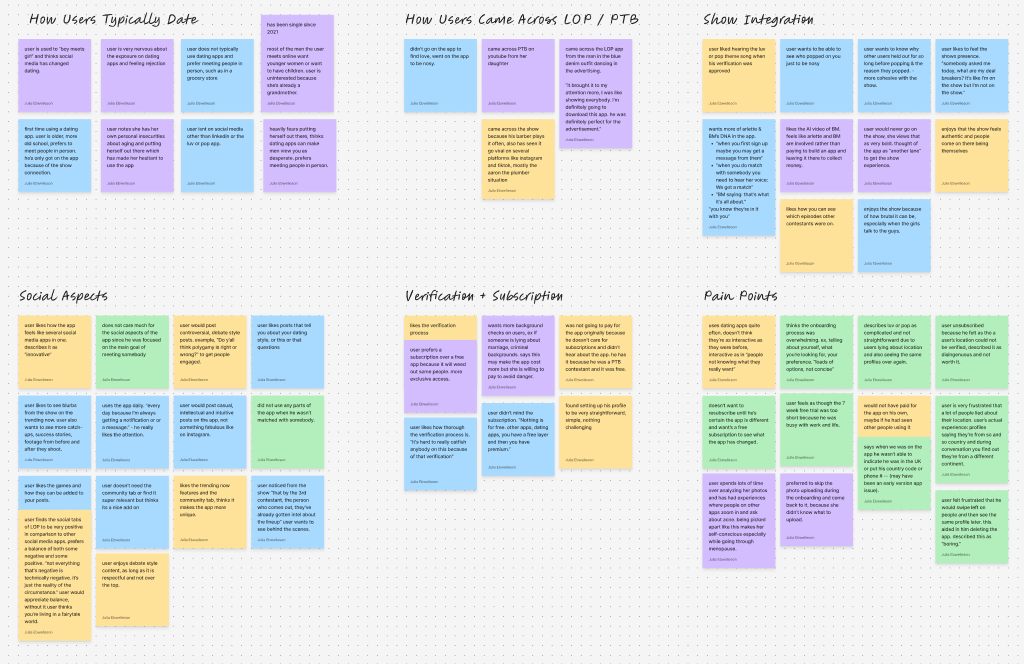
After each interview, I organized my notes by participant and then compared observations across interviews. I used affinity mapping to cluster related behaviors, motivations, pain points, and emotional signals and identify patterns across participants.
My Synthesis Process:
Reread interview transcripts -> Take notes on what stands out -> Affinity Mapping -> Patterns
One thing I noticed in my own research process was that I often wanted to move quickly from identifying a pattern to proposing a product solution. Through conversations with my team, I learned to pause at the insight stage and spend more time asking what the pattern might be telling us about the underlying user problem and the product experience.
This shifted my mindset from trying to find a revelatory solution right away to staying curious about the evidence.
Key Insights
01 — Users don't necessarily distrust verification.
I initially wanted to understand whether verification itself was creating friction. Interviews revealed a more nuanced picture: participants generally valued verification and saw it as a signal that people on the app were real. The larger trust issue came from inconsistencies around profile information, particularly location.
What this revealed: The problem wasn't simply getting users through verification. It was making sure the information they encountered afterward felt credible and transparent.
02 — Some onboarding friction is emotional, not functional.
For older participants who were less familiar with social and dating apps, profile creation introduced a layer of vulnerability that went beyond simply understanding what to do. One participant stalled at the photo-upload step because she felt uncomfortable putting herself online.
What this revealed: For some users, onboarding isn't just about completing tasks. It's about feeling comfortable enough to represent themselves publicly.
What we still need to validate: This pattern came primarily from older participants, so the team identified the need for additional research across other age groups (30-40) before treating it as a broader onboarding problem.
03 — Users experience Luv or Pop as a blend of dating, entertainment, and social connection.
Participants didn't always enter the product with a purely dating-focused mindset. The show's entertainment value helped drive discovery, while the social/community experience gave users another way to interact with the product outside of matching.
At the same time, social engagement was largely passive: participants described viewing content more than contributing to it.
What this revealed: The team needs to understand how social and entertainment experiences can reinforce the core dating journey, along with exploring why users may not make their own posts.
04 — Behavioral data showed where users were dropping off, interviews helped explain why.
Analytics could show changes in user behavior, but interviews surfaced experiences that weren't visible in the existing data, including users questioning the accuracy of profile locations, the authenticity of people they encountered, and emotional motivations.
What this revealed: Qualitative research added context to behavioral data and surfaced trust issues that the team hadn't been able to identify through analytics alone.
Six Product Areas
With my affinity mapping, I transformed my findings into six higher-level product areas that were easier to communicate and prioritize with cross-functional stakeholders. I translated the emerging themes into a prioritization framework based on urgency.
| Theme | Core User Problem | Urgency |
|---|---|---|
| 1. Verification, Trust & Location | Users encounter fake locations (e.g., claiming UK vs. different continent) and recycled profiles, harming trust. | 🔥 High – Significant trust concerns that may cause abandonment. |
| 2. Onboarding Anxiety | Older or more traditional users feel high anxiety and fear of exposure when building profiles. | 🔥 High – for user safety |
| 3. Matching & Intent | Users suffer from fatigue due to a lack of transparency regarding relationship goals (marriage vs. casual). | ⚠️ Medium – Users experience this from other apps, not directly LOP. |
| 4. Acquisition | Users are downloading the app because of its association with Pop the Balloon, rather than viewing it as a stand alone dating app. | ⚠️ Medium – Expected in the early stages of an app, eventually we'd want the app to reach people who also haven't heard of the show. |
| 5. Social Aspects & Feed Engagement | Users enjoy the multi-social-media feel, but passive viewing means people post without actively engaging with each other. | ⚠️ Medium – Good for retention, but we want to inspire users to post themselves. |
| 6. Show Integration | Users love Arlette and BM's [the show owner's] presence, trusting the app as an extension of the show. | 💡 Low – Already working well, can be scaled up iteratively. |
Reflection
My experience as a User Research and Product Design Intern at Luv or Pop has been transformative. One of the biggest takeaways was learning how to move from individual interviews to broader product insights through affinity mapping. Organizing the research visually helped me identify patterns and turn them into actionable themes.
I also learned the value of sitting with the problem before jumping to a solution. Bringing user pain points to the team for brainstorming, rather than immediately designing solutions myself, gave me more time to understand the underlying problems and notice connections I may have missed if I had rushed to a solution.
One area I would approach differently is recruitment. While four interviews surfaced valuable insights, I would have liked to speak with a larger and more diverse group of users. I underestimated how many participants would cancel or not show up, which made recruitment more challenging than expected. The team recognized the limitation of speaking to a small number of users, and for this 3rd round of interviewing, I'm aiming to speak to 30 different people.
In future research, I would build more follow-up into the recruitment process, including multiple reminders leading up to each session and stronger confirmation practices. This experience taught me that good research depends not only on the quality of the interviews, but also on the planning and persistence required to talk to your users.